
Appearance
SFP Style
SFPs mark liquidity events where price swept a key level and snapped back. CHoCH is the directional confirmation that follows. This section controls how these elements appear on the chart.
SFP
SFP (Swing Failure Pattern) occurs when price wicks above a range high or below a range low, then closes back inside on the same candle.
A stop hunt — institutional liquidity grab before a reversal.
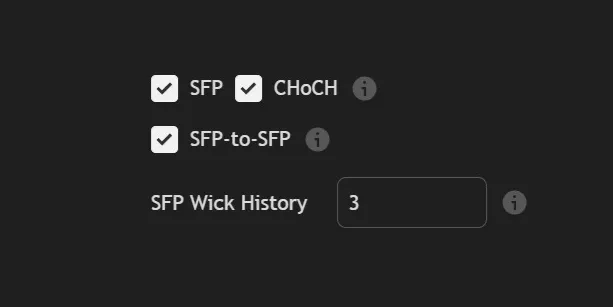
| 1. | SFP enables the display of confirmed Swing Failure Patterns and allows you to customize their colors. Detects confirmed SFPs on the HTF at range highs and lows. |
| +SFP is a sub-toggle of SFP. It shows a potential, unconfirmed HTF Swing Failure Pattern detected on the LTF — it may confirm when the HTF bar closes, or invalidate. Working as intended. |
| 2. | SFP-to-SFP enables the display of SFP-to-SFP patterns — when a Swing Failure Pattern forms at the level of a previous SFP rather than at a structure high or low. Two layers of stops cleared simultaneously — typically produces a sharper reversal. |
| 3. | SFP Wick History controls how far back the indicator looks to find valid SFP levels. Measured in breaks — a value of 3 means REx looks back up to three structural breaks to include SFP wicks as valid reference levels. |
CHoCH
CHoCH (Change of Character) is the first structural break in the opposite direction after an SFP.
The SFP is the rejection. The CHoCH is the confirmation. Together they form the basis of all four Wolf Setups.
INFO
The CHoCH line disappears if its source SFP level is broken — the setup has been invalidated. This is self-correcting behavior, not a bug.
| 4. | CHoCH enables the display of Change of Character lines and allows you to customize their colors. The CHoCH is always based on an SFP — it appears at the last high or low before the SFP, and draws when that level is broken, marking a potential trend shift. |